

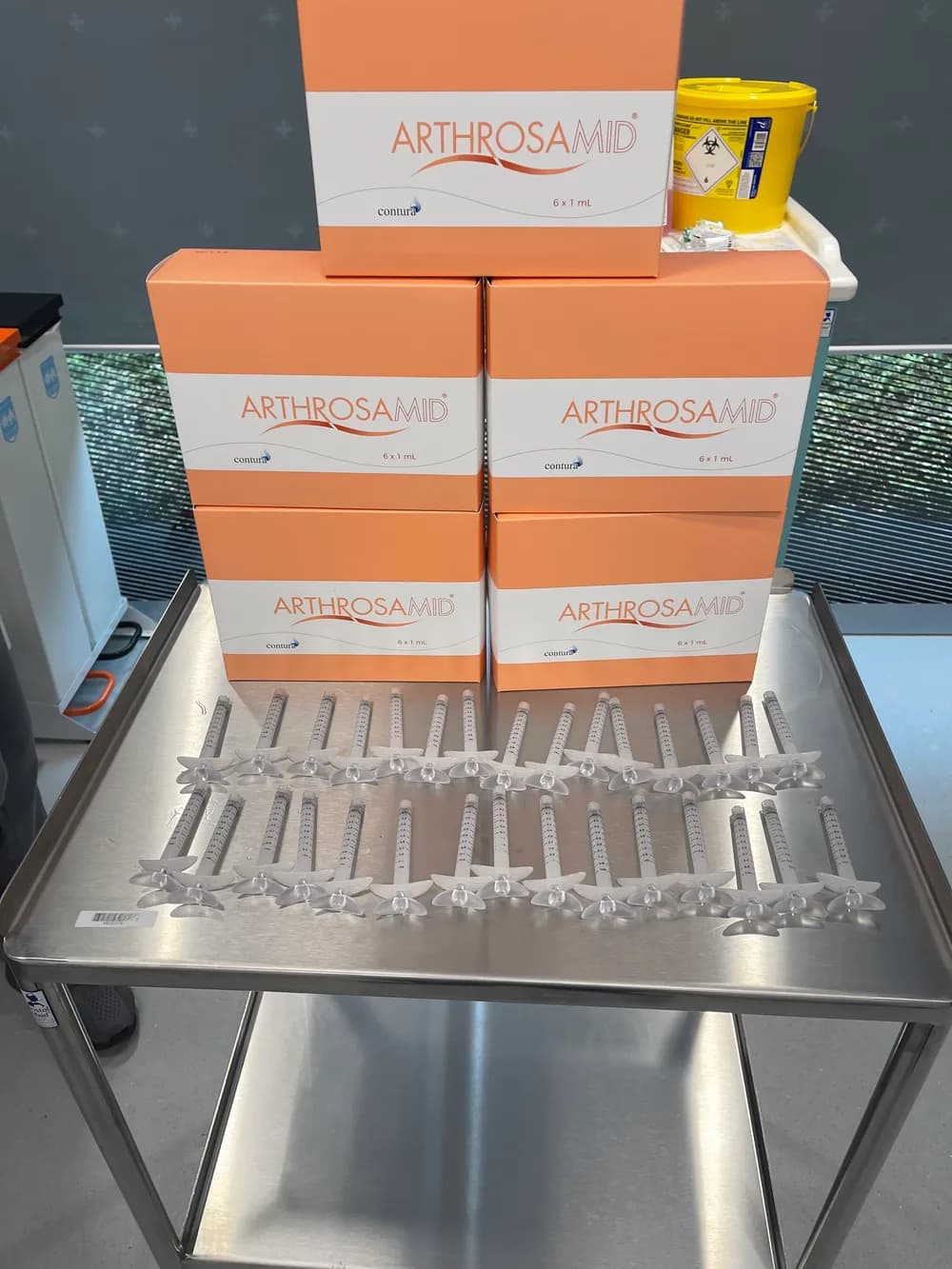
A milestone built through clinical practice
Professor Lee reports more than 1,200 Arthrosamid injections over five years. From bringing the treatment into UK practice to discussing longer-term outcomes with returning patients, that experience informs the questions his team asks about selection, technique and follow-up.
The milestone counts injections. The published research below provides the separate detail on patient groups, follow-up and outcomes.
Following 269 patients for two years
The 2025 study by Gao and colleagues, co-authored by Professor Lee, followed 269 patients with 314 treated knees in London and Lincoln. It recorded pain and function before treatment and at follow-up through 24 months. Average pain scores fell, while Oxford Knee and Lysholm scores improved.
There was no control group, so the results describe change in this cohort rather than prove that all improvement came from the injection. The paper also records pain, swelling, infections and subsequent knee replacements. The published correction updates the ethics approval reference; it does not revise the outcome data.
Building the evidence from different angles
In 2022, Cole, Maulana, Whitehead and Lee reviewed the early knee evidence: five reports covering 463 combined patient outcomes. The review identified encouraging symptom improvements and highlighted the developing evidence base.
A separate report by Maulana, Cole and Lee followed one patient’s symptoms and MRI findings over four months. It documented a reduction in patellofemoral bone marrow lesions alongside improved function. That observation helps frame research questions; it is a single case, not a population success rate or proof of cartilage regeneration.
Digital tools that support the conversation
The group’s Arthrosamid self-assessment tool is already available through London Cartilage. It gives patients a structured way to explore suitability before a clinical discussion. AMSK also links to the MSK Doctors patient portal.
These tools sit alongside the consultation. A questionnaire result is a starting point for assessment, not a diagnosis or a prediction that treatment will succeed.
Sharing the experience with clinicians
The AMSK masterclass and clinical visits offer healthcare professionals a way to discuss Professor Lee’s experience directly: why a treatment is considered, how the injection is performed and what happens during follow-up. The papers provide a useful starting point for those discussions.
Sources and further reading
- Professor Lee: joint injections and clinical experience
- Gao et al. (2025): 24-month prospective knee cohort
- Published correction: ethics approval reference
- Cole, Maulana, Whitehead & Lee (2022): systematic review
- Maulana, Cole & Lee (2022): patellofemoral MRI case report
- London Cartilage: Arthrosamid self-assessment
- MSK Doctors patient portal
General information to support a clinical conversation. AMSK and Professor Lee are part of the MSK Doctors group; group publications are identified above.
Editorial review notes · Preview only
The three local PDFs and the published corrigendum have been checked. Digital copy now names the existing self-assessment tool and patient portal. Confirm whether Paul intends to feature a different app; no unverified app features or “most published” ranking are claimed.